





















STEM Education and the Girl-Child
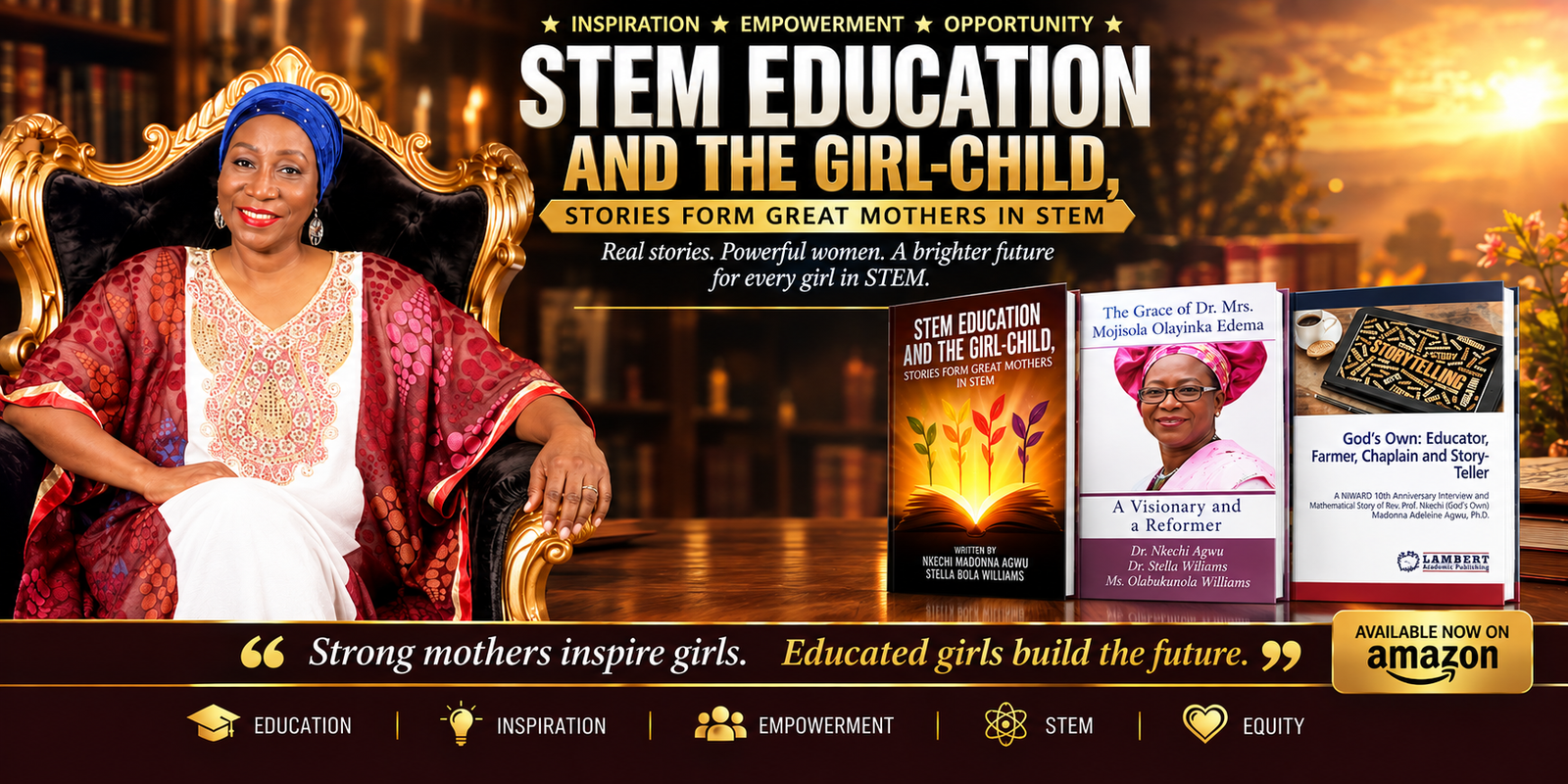
Featured Books:
STEM Education and the Girl-Child: Stories from Four Great Moms in STEM
STEM Education and the Girl-Child: Stories from Four Great Moms in STEM is an inspiring collection of personal stories from four accomplished women who have built successful careers in science, technology, engineering, arts, and mathematics (STEAM). Through their unique journeys, they share the challenges they overcame, the lessons they learned, and the values that shaped their lives. Their stories celebrate education, resilience, faith, and the determination to break barriers while encouraging young girls around the world to dream big and pursue their ambitions with confidence. Whether you are a student, parent, educator, or mentor, this book offers hope, inspiration, and practical wisdom for anyone who believes in the transformative power of education and perseverance.
God's Own: Educator, Farmer, Chaplain, and Storyteller
This is an interview story of Rev. Prof. Nkechi (God's Own) Madonna Agwu, Ph.D., aka NMA (Beautiful) Jacob, to commemorate the 10th anniversary of the Nigerian Women in Agricultural Research for Development (NIWARD). God's Own tells her mathematical story as a versatile woman, wearing several hats as an educator, farmer, chaplain, mathematical storyteller, and many more. She is a NIWARD talking drum, shekere musical instrument, and colorful Akwete cloth.
This book is a sequel to her renowned book, God's Own: The Genesis of Mathematical Storytelling. God's Own is a founder and CEO of Chi STEM Toys Foundation, a 501(c)(3) organization birthed out of her research and educational endeavors, with a mission of facilitating science, technology, engineering, arts and mathematics (STEAM) and entrepreneurship education in rural communities and among vulnerable, underprivileged, and underrepresented groups. This book is helping to fulfill that mission. Through this book, God's Own gives God (the Absolute Infinite) all the glory for the great and mighty things He has done in her life.
The Grace of Dr. (Mrs.) Mojisola Olayinka Edema: A Visionary and a Reformer
The Grace of Dr. (Mrs.) Mojisola Olayinka Edema née Fatungase: A Visionary and a Reformer
August 1, 1968 – March 1, 2015
A blessed and godly life of 46+ years
Teacher, grassroots advocate, community and nation builder
“She always carried others along to move them up to a glorious place.”
The Grace of Dr. (Mrs.) Mojisola Olayinka Edema: A Visionary and a Reformer_ is a splendid “Aso-oke” compilation of stories and articles about this noble and graceful lady. It is a “talking drum” of coded, colorful messages honoring and celebrating the life and legacy of this humble, straightforward, and great Nigerian woman, wife, and mother. She may be gone from this world, but her spirit lives on through the numerous lives she touched in positive ways.
The late Dr. (Mrs.) Mojisola Olayinka Edema née Fatungase was a virtuous woman with a strong faith in God. She advocated strongly for the emancipation and empowerment of women and girls. She was an educator who believed in the power of knowledge. She was loved by her students. She was a community and nation builder. She was a woman who always carried a smiling face, no matter what challenges, problems, or difficult issues she was facing. Despite the lack of longevity of her life, it was a life well lived. It is a life worthy of emulation. It is a life that definitely takes a front-row seat among the great leaders and scientific geniuses of the 21st century.
The late Dr. (Mrs.) Mojisola Olayinka Edema was a pioneer of the Nigerian Women in Agricultural Research for Development (NIWARD). She was the former Acting Director of the Centre for Gender Issues in Science and Technology (CEGIST), Federal University of Technology, Akure (FUTA), and a food microbiology faculty member at this institution. Her area of emphasis as a food microbiologist was Nigerian traditional foods.
Too often, successful and influential African women leaders and geniuses do not get the recognition they deserve. Their stories are usually invisible to people outside their realm of direct impact. So, they hardly make it into the global history records in their fields of success and influence. This severely limits the effect of their biographies in nurturing, grooming, and guiding young girls and others for leadership roles and success in their professional and other life endeavors.
This publication brings recognition to the late Dr. (Mrs.) Mojisola Olayinka Edema by honoring and celebrating her life and legacy. Although it does not completely reflect all facets of this great and marvelous lady, it provides a glimpse into the “Aso-oke” fabric of her inner being, character, professional work, mentoring roles, volunteer service, and community- and nation-building endeavors. We know it will serve as a path or a shining star to follow for young women and girls who aspire to be leaders and nation builders, and for all others who would like to walk the walk in similar aspects of her journey through life.
About The Author
Four women. Four journeys. One shared commitment to the transformative power of STEM and STEAM education.
Nkechi Agwu is the daughter of Jacob Ukeje Agwu (16 August 1925–7 June 2008) and Europa Lauretta Durosimi Wilson, who was a schoolteacher. Jacob Agwu was the only surviving child of his parents, five of his siblings having died in infancy. After showing excellent abilities at school, he taught at the primary school he had attended for three years before training as a teacher at St. Charles College, Onitsha. He taught arithmetic and geography before going to Fourah Bay College, Freetown, Sierra Leone, where he earned a B.A. in Economics and Geography in 1955. He went on to obtain a Master's degree at University College, Ghana. While in Ghana, he met Europa Lauretta Durosimi Wilson, who, in fact, was from Freetown, Sierra Leone. They were married in December 1957 and had five children.
At the time Nkechi was born, Jacob was Senior Assistant Secretary in the Premier's Office, Enugu, Nigeria. She was born at Parklane General Hospital, Government Reservation Area, Enugu. Her parents were Christian, and Nkechi was baptized a few weeks after her birth at the Holy Ghost Cathedral, Ogui, Enugu, Nigeria, on November 4.
Nigeria became an independent country in 1960, ending its time as a British colony, so Nkechi was born into independent Nigeria. The Biafran War, however, broke out in July 1967. A military coup in 1966 was a significant factor in the outbreak of the war, which was fought between government forces and the state of Biafra, which was seeking independence motivated by ethnic and religious differences. Jacob Agwu was a Biafran and supported Biafra during the Nigerian Civil War, helping with the logistics of supplying their army. Nkechi Agwu writes:
My ancestral village, Alayi, was devastated by Nigerian soldiers during this war. ... Prior to the capture of my ancestral village, Alayi, by Nigerian soldiers, my elder brother Oba would usually drive us there in the mornings to avoid the day bombings of Umuahia by Nigerian war planes, and bring us back at night. Knowledge of my ancestral village, Alayi, is the only good memory I have of this war. My siblings and I visited Alayi more times during the war than in the entire years of my childhood before the war.
One day, their home in Umuahia was badly damaged in a bombing raid by Nigerian planes. In 1968, Europa, Nkechi, and the other children left Nigeria and were evacuated on the last Red Cross refugee flight for Biafrans. They were taken to a refugee camp in Fernando Po, Equatorial Guinea, but the plan that Europa would return, leaving the children, did not work out as there were no further Red Cross flights. After a few months at the Fernando Po refugee camp, they were granted visas to enter Sierra Leone, but only on condition that Europa accompanied her children.
They were taken from Fernando Po by ship to another refugee camp in Monrovia, Liberia. Next, a plane flew them to a third refugee camp in Freetown, Sierra Leone, where they arrived on October 4, 1968. They intended to live with Europa's mother, Hannah, Nkechi's maternal grandmother, but when they reached Sierra Leone, they discovered that the grandmother's house had been burned down. Being homeless, the family was split up, and Nkechi, with her mother and younger brother Ifeanyi, was housed with the Leigh family at Congo Cross. Europa was the only one in the family with an education, so she had to find a job and make a home for her family. This made Nkechi realize just how important it was to receive an education.
The Biafran War claimed over 2 million civilian lives, but it ended in January 1970 when the Biafrans were defeated. Some months after the war ended, Nkechi's mother, Europa, returned to Nigeria. They had been refugees for four years, living in hardship. Because of his involvement in the war, Jacob decided to leave the Nigerian Civil Service and took up farming. His influence on Nkechi and her siblings was an important factor in how her life developed. Jacob Agwu:
... always had time for his children ... He instilled in them virtues of hard work, discipline, integrity and a love for knowledge and learning. ... His philosophy was that if you give a man a fish you feed him for a day but if you teach him to fish you feed him for life. He believed that education was critical to life and development.Although Nkechi's mother returned to Nigeria, Nkechi remained in Sierra Leone, attending the Fourah Bay College University Primary School in Freetown. She graduated from that school in 1973 and began her studies at the Annie Walsh Memorial School in Freetown. She spent two further years, 1978–80, at the Freetown Secondary School for Girls before returning to Nigeria.
Agwu was fascinated by mathematics as she grew up and saw mathematics in so many things around her. For instance, she said:
... my own grandmother [Omamma] taught me to play a cultural brick game that is popularly known as Mancala; we call it Okwe. Even though she never went to school, she was an expert player. I was convinced my grandmother was a mathematician because she could see 10 moves, 20 moves ahead.Agwu studied mathematics at the University of Nigeria, Nsukka, graduating with a [http://B.Sc](http://B.Sc "smartCard-inline") . (Hons.) in 1984. She was awarded “Best Graduating Student” in the Department of Mathematics. She had undertaken an honors project, “On the Stability of Solutions of Constant Coefficient Second Order Equations and Systems,” advised by James Ezeilo. She was also taught by Isabelle Adjaero, the only woman on the faculty, who had studied at the University of Connecticut in the USA for her doctorate, advised by Eugene Spiegel.
Both Ezeilo and Adjaero encouraged Agwu to go to the University of Connecticut for postgraduate study. Adjaero wrote a strong letter of recommendation to Eugene Spiegel, and Agwu was accepted onto the graduate program at the University of Connecticut and offered a place starting at the beginning of the 1986–87 session.
She worked for one year as a statistician in the Federal Office of Statistics (1984–85) and was then appointed as a lecturer at Kaduna Polytechnic in Kaduna in 1985. She delayed her start at the University of Connecticut, spending two years lecturing at the Polytechnic before going to the United States in January 1987 to study for her Master's degree. She had delayed her admission because of lack of finance.
Her studies were funded by a Mathematical Association of America travel award and an award to fund the study of the uses of the history of mathematics in teaching. She arrived in New York in the middle of a snowstorm, the first time she had seen snow. Starting the graduate studies one semester late gave her a difficult start, but after exceptionally hard work, she was awarded her Master's degree in 1989.
She carried on at the University of Connecticut, aiming for a Ph.D. in pure mathematics, but soon gave up and decided to change to mathematical education. This was impossible at the University of Connecticut, so, in 1990, she went on to study for a doctorate in mathematical education at Syracuse University in New York. Her advisor at Syracuse was Howard Johnson, and Agwu was awarded a Ph.D. in 1995 for her thesis, _Using a Computer Laboratory Setting to Teach College Calculus_. She wrote:
At Syracuse University, I worked as a teaching fellow and as a teaching associate in the Mathematics Department. I received a few honours at Syracuse University such as the Future Professoriate Award, a Creative Dissertation Award, and the Chancellor's Meritorious Service Award for Student Leaders. I served in a number of student leadership capacities, which included service as a President of the African Students Union, as a President of the Association of International Students at Syracuse University, and as a Mathematics Department Graduate Student Organisation Senator.After the award of her Ph.D., Agwu had hoped to return to Nigeria but, having been forced to resign from Kaduna Polytechnic when she went to the United States, she had no job to return to in Nigeria. Consequently, she decided to remain in the United States and was appointed as a graduate teaching assistant and a Coordinator of the Teaching and Learning Center at the Borough of Manhattan Community College, City University of New York.
Agwu married Nicholas C. B. Ogbonna and had a son, Ngozichukwuka Jacob A. D. Agwu, born on Friday, October 9, 1998. Nicholas Ogbonna had worked as a Red Cross volunteer for Biafra, supervised by Agwu's mother. Sadly, Agwu had to spend time away from her husband, and he suffered from diabetes, which was treated with insulin. He died from complications arising from the diabetes.
At the Borough of Manhattan Community College, students had to take one course that was writing-intensive. Agwu said:
That gave me the impetus to teach Discrete Mathematics as a writing-intensive course. Doing so would offer me a unique opportunity to bring forward some of my ideas around mathematics and the many ways it connects with my students' lives. So I started to look at things I was familiar with from my specific cultural perspective, as a Nigerian, a Sierra Leonean and an American, and their relationship to the mathematical concepts my students needed to understand.How did she do this?
To put her teaching philosophy into action, Agwu introduced games, cryptography, African doll-making, textile design, genealogy trees and graph theory. She had her students study the structures and floor plans of Nigerian palaces and the lives of female mathematicians and plot their own biographies as graphs.From 1997 to 2002, Agwu studied the history of mathematics, particularly writing biographies of African or African-American mathematicians and scientists. She received professional development in these areas during these years from the Mathematical Association of America's Institute in the History of Mathematics. She chaired a Mathematical Association of America team that developed historical modules in “Linear Equations and Polynomials.”
She was an author of the paper _Dr. J. Ernest Wilkins, Jr.: The Man and His Works (Mathematician, Physicist and Engineer)_ (1997) and _Dr. David Harold Blackwell, African American Pioneer_ (2003). In 2000, she was the first to receive an award from the American Mathematical Association of Two-Year Colleges to develop a course to teach statistics using biographical material.
In July 2009, Agwu was elected as president of the New York City branch of the American Association of University Women.
As its president, Agwu leads its efforts in advancing the mission of the American Association of University Women through advocacy, research and education. She describes her agenda for the branch: "I especially want to ensure that the New York City branch reflects the value promise of the American Association of University Women as an organization that breaks through educational and economic barriers so that all women will have a fair chance." Under her watch, the chapter has initiated a number of programs precisely to equip women and girls with skills to help them break through those barriers. There's a mathematics and computer literacy program that is aimed not only at high-school and college students, but also at adults interested in developing their mathematical and computer skills ...In 2014, Agwu received a Carnegie Africa Diaspora Fellowship, which allowed her to spend three weeks in Nigeria on the project _Culture and Women's Stories: A Framework for Capacity Building in Science, Technology, Engineering and Mathematics (STEM) Related Fields_. She said:
The goal is to develop curricular materials that are culturally based and gender sensitive and to train educators in Nigeria to use them to teach mathematics and other STEM disciplines. The idea is to foster student innovation and creativity linked to the science and technology of their cultures.Let us end by quoting from Nkechi Agwu:
I am Nigerian, Sierra-Leonean, African-American widowed woman, who is a survivor of the civil wars of Nigeria, Sierra Leone and the 9/11 World Trade Center terrorist attacks. The trajectory of my life includes experiences of displacement, homelessness, living in refugee camps, single parenting of a child with hearing and speech needs and many other issues that from all indications could have set me up for failure. However, despite the odds against me which included being the sole Black female student in the graduate mathematics programmes of the University of Connecticut and Syracuse University, while I was a student there, I was fortunate to have access, opportunities, and avenues to excel in mathematics and other areas relevant to public service in STEM ...Available on Amazon
Stem Education and the Girl-Child: Stories from Four Great Moms in Steam Education!
God's Own: Educator, Farmer, Chaplain and Story-Teller
The Grace of Dr. (Mrs.) Mojisola Olayinka Edema: A Visionary and a Reformer
Marketing Partner: Pro Author Publishing
This article has been sourced from various publicly available news platforms around the world. All intellectual property rights remain with the original publishers and authors. Austin Release does not claim ownership of the content and provides it solely for informational and educational purposes voluntarily. If you are the rightful owner and believe this content has been used improperly, please contact us for prompt removal or correction.